
Last Updated on April 10, 2026 by Hemant Beniwal
“IPO does not stand for Initial Public Offering. It stands for It’s Probably Overpriced.” – Benjamin Graham
Your WhatsApp group is buzzing about the next big IPO. Your colleague made ₹50,000 on listing day. Your Telegram channel says “apply karo, guaranteed listing gains.” So why shouldn’t you jump in?
Because the stories you hear are from the winners. The losses stay quiet. In early 2026, 7 out of 11 mainboard IPOs gave negative listing gains. SME IPO listing gains crashed from over 60% in 2024 to just 2.63% by early 2026. The party isn’t what it used to be.
I’ve watched IPO manias come and go since 2003. The Reliance Power IPO of 2008, the LIC IPO of 2022, the PayTM listing. Every cycle has the same script: euphoria, oversubscription, reality check. Let me walk you through 6 myths that cost Indian investors money every IPO season.
⚡ Quick Answer
Most IPO myths revolve around guaranteed listing gains, company stability, and retail investor advantage. In reality, IPOs are priced for the seller’s benefit, not the buyer’s. SEBI data shows SME listing gains collapsed to 2.63% in early 2026, and 7 of 11 mainboard IPOs listed negative. The smart approach: skip the hype, let the stock prove itself post-listing, and invest through mutual funds if you want IPO exposure.
Must Read – Why Most Indian Retail Investors Lose Money in Stocks
6 IPO Myths That Cost Indian Investors Money
Myth 1: More Information Means Better Decisions
When a well-known brand comes for listing, the media blitz is overwhelming. TV channels, newspapers, Instagram reels, YouTube breakdowns. The sheer volume of information creates an illusion of confidence. You feel like you “know” the company.
But information isn’t the same as insight. Remember the Reliance Power IPO in 2008? The largest IPO in Indian history at the time, with the highest retail subscriptions ever. The media coverage was relentless. And the stock crashed on listing day. The same pattern repeated with PayTM in 2021.
More data doesn’t mean better decisions. It often means more noise.
Myth 2: Public Excitement Means Good Investment
A well-loved brand can still be a terrible investment at the wrong price. SBI is India’s largest bank by every metric: customers, branches, deposits, loans. Yet HDFC Bank, at less than half SBI’s operational size, had double its market capitalisation for years.
Brand popularity and investment value are two completely different things. The LIC IPO proved this. India’s most trusted insurance brand, massive customer base, incredible brand recognition. And the stock traded below its IPO price for years after listing.
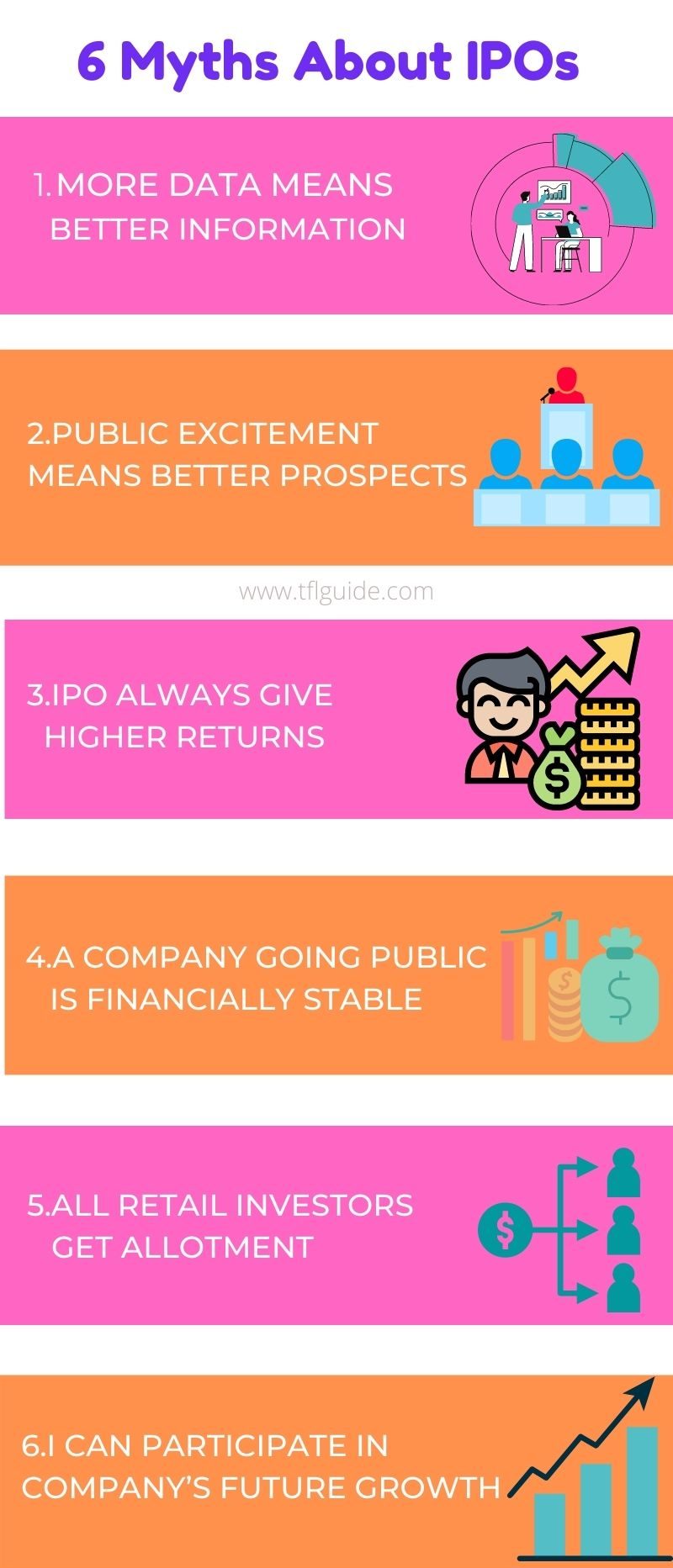
Myth 3: IPOs Always Give Higher Returns
This is the most dangerous myth. Historical data consistently shows that most wealth in an IPO goes to the sellers, not the buyers.
As Warren Buffett said: “It’s almost a mathematical impossibility to imagine that, out of the thousands of things for sale on a given day, the most attractively priced is the one being sold by a knowledgeable seller to a less-knowledgeable buyer.”
Think about it. When would you sell your house? When you can get the maximum price, or when it’s “fairly” priced? Promoters and VCs time their IPOs to maximise their exit value. The retail investor gets what’s left.
SME IPO average listing gain: 2024 = 60%+ | Early 2026 = 2.63%. That’s not a correction. That’s reality catching up.
Myth 4: A Company Going Public Is Financially Stable
Going public means the company met SEBI’s listing requirements. It doesn’t guarantee profitability, stability, or even survival. BYJU’S was preparing for an IPO while simultaneously being called out for questionable sales practices. Many companies that listed in 2021-22 during the bull run are now trading 50-70% below their issue price.
SEBI has tightened norms since 2024: higher minimum IPO sizes for SMEs (₹10 crore), doubled minimum retail application to ₹2 lakh, and proposed caps on first-day listing gains at 90%. These reforms exist because the old system wasn’t protecting retail investors.
Myth 5: All Retail Investors Get Allotment
In oversubscribed IPOs, the retail quota (35%) uses a lottery system. With average oversubscription of 23x, only 1 in 24 retail investors gets allotted. Your money is blocked for 5-7 days during the application process. If you don’t get allotted, you earned zero returns on that blocked capital. Do this 10 times a year and you’ve lost significant opportunity cost.
Myth 6: You’re Participating in Future Growth
By the time a company reaches IPO stage, most of the explosive growth has already been captured by VCs, PE funds, and early investors. The IPO is their exit strategy, not your entry strategy. You’re buying at the point where insiders are selling. That alone should make you pause.

Caught up in IPO fever?
A structured financial plan helps you invest based on goals, not hype.
What Nobody Tells You About IPO Investing
Here’s the part that IPO cheerleaders, brokers, and finfluencers will never say.
If you’re convinced that a company is worth investing in, you can always buy it after listing. The stock will be available on the exchange at market price. If the company is truly good, it will still be a good investment 6 months after listing, likely at a more reasonable valuation.
The urgency to “get in at IPO price” is manufactured. It’s FOMO dressed up as financial strategy. Benjamin Graham wrote about this 70 years ago: “Somewhere in the middle of a bull market, new issues start appearing. These are priced not unattractively at first. As the market rises, the quality of companies drops while the prices asked become exorbitant.”
The fact that you need to apply for an IPO during a specific window, with money blocked, competing with 23 other applicants for one slot, should tell you something about who this system is really designed for. It’s not designed for your benefit.
If you want exposure to IPOs without the gamble, invest through mutual funds. Many large-cap and flexi-cap funds are anchor investors in IPOs and can participate at scale with better due diligence than any retail investor can do alone.
Read – 7 Types of Indian Investors: Which One Are You?
The best IPO strategy? Don’t need one.
A diversified portfolio through mutual funds and SIPs beats IPO gambling for 99% of investors.
Frequently Asked Questions
Should I invest in IPOs for listing gains?
Listing gains are unreliable. In early 2026, 7 of 11 mainboard IPOs had negative listing gains. SME listing gains crashed from 60%+ to 2.63%. If you’re treating IPOs as a quick money strategy, you’re speculating, not investing. A long-term SIP in a quality mutual fund will almost certainly outperform IPO gambling over 10+ years.
Is LIC a good stock to hold after its IPO?
LIC’s IPO price was ₹949. It traded below that level for extended periods after listing. As of 2026, it has recovered but the journey was painful for investors who expected quick returns. The lesson: even the most trusted Indian brand can be a bad investment at the wrong price. Always evaluate valuation, not just brand recognition.
What SEBI reforms have changed the IPO landscape?
Since 2024, SEBI has raised minimum SME IPO size to ₹10 crore, doubled minimum retail application to ₹2 lakh, proposed caps on first-day listing gains at 90%, introduced a draft abridged prospectus for better transparency, and tightened disclosure norms. These reforms aim to protect retail investors from low-quality listings.
How can I invest in IPOs safely?
The safest approach: invest through mutual funds that participate as anchor investors. If you must apply directly, limit IPO investments to 5% of your portfolio, only apply for companies with proven profitability (not concept-stage businesses), and be prepared to hold for 3-5 years rather than flipping on listing day.
An IPO is not an invitation to a party. It’s an invitation to buy someone else’s exit. Make sure you know the difference.
It’s not a Numbers Game… It’s a Mind Game.
💬 Your Turn
Have you ever applied for an IPO expecting listing gains and been disappointed? Or made money? Share your real experience in the comments.